

 LinkedIn
A $29 AI visibility tracker will tell you when ChatGPT recommends your competitor. It will not make ChatGPT recommend you. For a small business doing the work in-house or with outside help, the recurring bill can run roughly $1,650 to $6,200 a month, depending on the work required and who does it. Technical setup may add a one-off charge. The subscription is usually the cheapest line item and the least useful one on its own.
I watched the same pattern play out in paid search. A bid-management tool could show me wasted spend; it could not write better ad copy, clean up search terms or repair broken conversion tracking. The fee bought visibility into a problem. The labour to fix it was the real budget. AI search has inherited that pricing trick, right down to the dashboard that turns red while everyone discusses whose job it is to change the page.
Here are the line items. Do not add every row together: some are alternative ways to buy the same work, and the technical setup is a one-off rather than a monthly charge.
| Line item | Listed price or omission | Cost to budget for | Timing | What drives it / source |
|---|---|---|---|---|
| AI visibility tracker | Entry plans from $29/month | $89–$499/month as prompt and engine coverage grows | Recurring | Query limits and engine count; see Otterly and Profound pricing. |
| Query compute beneath a tracker | About 5¢–12¢ per check | Roughly $10/month per prompt checked across four engines daily | Cost benchmark, not a separate bill on every plan | AuditAE’s query-cost breakdown. |
| Technical audit and setup blueprint | Not included in tracker pricing | $1,400–$2,100, with implementation potentially still on your team | One-off | Scope can include crawl access and structured data; see Tapas SEO’s AI bundle. |
| Answer-first content | Not included in tracker pricing | About $1,580–$3,200/month for 16 hours | Recurring | Writing and editing time at the GoodFirms rate benchmark of $98.90–$200/hour. |
| Digital PR and entity mentions | Not included in tracker pricing | $500–$2,000/month | Recurring | The amount of off-site work required. |
| Specialist AEO agency | $3,000–$10,000/month | $3,000–$10,000/month, before excluded implementation work | Recurring | Scope and contract terms; see Pepper Effect’s agency comparison. |
| Autonomous execution through groas | Flat per domain | Flat per-domain fee | Recurring | An execution model rather than a tracker or an hourly retainer. |
The table separates two purchases vendors often blur: knowing where you are absent and doing the work that might change that. A tracker sells the first. Content, technical repairs and off-site mentions make up the second. Now for what each route puts on your team.
Route 1: Buy a tracker and do the work in-house
The listed cost: a subscription with prompt limits
Starter plans look modest at $29 to $89 a month. The catch is coverage: a tier tracking 15 to 25 queries will not describe much of the buyer journey for a local HVAC installer or a niche B2B accounting firm. Regional wording, comparison searches and high-intent questions can take the list to 60 or 100 variations before you have tracked them across multiple engines.
At 100 prompts across ChatGPT, Perplexity and Google AI Overviews, the price cited for Peec AI reaches $199 a month. Higher-volume plans can put a tracker in the $399 to $499 bracket. That is $2,400 to roughly $6,000 a year at those monthly prices before anyone changes a line of copy. Ask what the plan counts as a prompt and which engines it covers before treating the entry price as your budget.

The hidden cost: someone has to turn charts into tasks
A tracker identifies where you are missing. It does not decide whether the cause is thin content, a crawl problem or a stronger third-party source. The gap between diagnosis and action shows up in comparisons of Profound, Peec and Otterly workflows, and it shows up in payroll.
Say a marketing manager spends two hours each Monday reviewing prompts, exporting results and deciding what to investigate. That is eight hours a month. At the draft’s illustrative loaded cost of $50 an hour, $400 a month goes to inspection alone. No answer page has been written. No crawler block has been fixed. You bought a speedometer for an engine that still needs work.
The recurring cost: pages that answer the buyer’s question
A page needs to give a search system something clear to retrieve and a buyer something worth reading. Generic marketing copy does neither. Definitions, direct answers and useful comparison tables take research and editing; the point is not to scatter a few AI-friendly phrases over an old landing page. The discussion of how ChatGPT recommends websites is a reminder that publishing a page and earning a mention are different events.
Budget roughly 16 hours of experienced writing and technical editing for four targeted pages in a month. At the GoodFirms hourly benchmark, that is about $1,580 to $3,200 monthly. Those hours may land on an employee rather than a contractor’s invoice, but they are not free. If a page misses the buyer’s question, paying less to produce it does not make the work economical.
The one-off cost: making the site accessible
Then there is the site itself. If a firewall blocks unfamiliar crawlers or client-side rendering leaves an answer table out of the HTML a crawler receives, stronger writing will not solve the access problem. Someone has to inspect crawl rules, rendering and structured data, then make and verify the relevant changes.
An agency’s technical setup bundle puts that audit-and-blueprint work at $1,400 to $2,100 as a one-off. Read the deliverables closely. A blueprint that mentions robots.txt, llms.txt and JSON-LD is not the same thing as deployed, tested changes on your production site. If your developer still has to implement it, that labour remains on your side of the ledger.
Route 2: Add a freelancer to the software bill
Hourly help moves the work, not the uncertainty
The usual next step is a specialist who can turn tracker findings into copy or technical tasks. That can be sensible. It can also make a $199 subscription look cheap right up until the hours arrive.
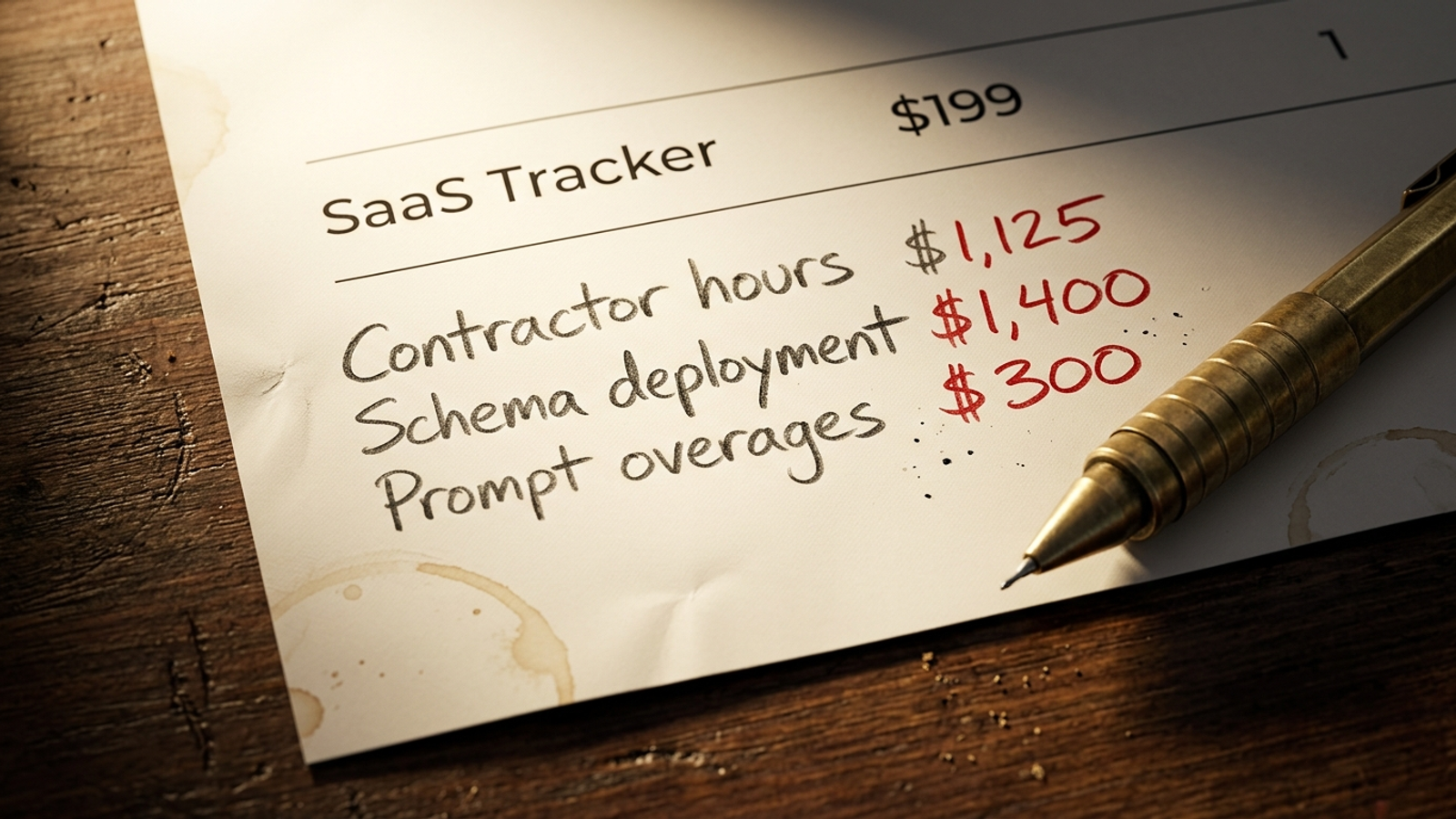
Take the draft’s illustrative $75-an-hour freelancer. Three hours reviewing a report, two hours on a progress call and five hours writing one article already account for ten billable hours. If the month reaches 15 hours, the fee is $1,125, bringing software plus labour to $1,324 before technical fixes or off-site work. The problem is not that a contractor bills for time spent. It is that the dashboard has no obligation to limit the time the work takes.
When a tracked prompt loses a citation the following week, someone must investigate it. A contractor can do that, but the diagnosis is another task on the bill. Ask what ships each month, not just what the hourly rate is.
More queries can raise the tracker bill too
Freelance help often reveals how narrow the starter plan was. Once you add regional phrasing, long-tail questions and competitor comparisons, a 50-prompt allowance can become the constraint. In the Peec AI comparison, moving from 100 to 300 tracked queries takes the quoted software price from $199 to $499 a month: another $300 to observe a wider set of prompts, before paying anyone to act on them.
That is worth separating from the compute beneath the service. AuditAE’s cost breakdown puts daily checks of one prompt across four engines at roughly $10 a month in underlying query cost. Software includes more than raw checks, but a higher tracking bill still buys monitoring, not execution. Software plus 15 freelance hours and a larger plan can put this route around $1,600 to $2,200 a month without covering every page, code change or mention you need.
Route 3: Pay for execution rather than recommendations
A retainer must include the work that reaches production
A specialist agency can take on more of the workload, at a very different price. AEO agency comparisons put retainers at $3,000 to $10,000 a month, with six-month commitments appearing in the market. That is not automatically a bad purchase. It becomes a bad one when the contract buys audits and revised articles while schema deployment, crawler access and publishing remain your team’s job.
This is why I would price the service by shipped work, not the number of prompts in a report. The same principle runs through structuring an AEO retainer around execution. Check who can make changes, who verifies them and what happens when an old page needs updating. If a $4,000 monthly provider sends recommendations for your developer to implement, include the developer’s hours in your comparison. The PDF is not the finished product.
An autonomous model is the more direct alternative to that hand-off. groas runs its organic-search and AI-citation service for a flat monthly fee per domain, with continuous execution rather than hourly billing: content, technical fixes, citation work and multi-engine tracking operate within client guardrails, with a named strategist accountable for direction. The point of the flat fee is not that every domain needs identical work. It is that the service, rather than your internal queue, takes responsibility for doing it.
Check exclusions before comparing prices
Put two offers side by side and ask these questions:
- Who publishes the content? A draft in a shared folder is not a live page.
- Who changes and verifies the site? A crawl audit is not a fix deployed to the CMS or server.
- Who handles off-site work? Your own pages cannot supply every third-party mention.
- Who revisits old work? A page that once earned a citation may need an update.
A cheaper quote with all four tasks excluded can cost more in team hours than a higher quote that includes them. A costly quote that excludes them is worse: you pay agency prices and retain the DIY workload.
Measure cited prompts, but do not buy a made-up forecast
Tracker vendors prefer cost per tracked query because it makes a subscription easy to compare. I care more about cost per cited commercial prompt: total spend divided by the relevant prompts where an engine actually names your brand. If you monitor 100 questions and appear in seven answers, the other 93 still matter, no matter how neat the dashboard looks.
That metric belongs in your own reporting, not in a sales table promising a fixed number of wins. Citations depend on the query, the available sources and the work that reaches production. Record a starting point, count the prompts that matter to buyers and compare the change against the full monthly cost, including your team’s hours. Dividing a $199 tracker invoice by cited prompts while leaving out the writer and developer is the same accounting trick as calling a bid-management subscription your entire PPC budget.
The costs that keep coming back
Old pages need attention after they ship
Content is not a one-time purchase. Search results and AI answers change; a page that answered a buyer’s question well can stop appearing in a response. Under an hourly arrangement, investigating and rewriting it adds billable time. Under a fixed deliverables contract, an update can compete with the next scheduled article. Neither problem appears in a tracker’s pricing table.
This is where execution capacity matters more than the number of charts. Someone has to notice the change, decide whether the page needs work and publish that work. A monthly report does not maintain last month’s pages.
Waiting has a cost even without a new invoice
A team can spend months watching its absence while content and technical requests wait in separate queues. Six months of a $199 tracker costs $1,194 in subscription fees. That arithmetic is simple; the harder cost to put on an invoice is the work you did not ship during those months. A competitor answering the buyer’s question while you hold another review meeting does not need your dashboard to look impressive.
Who can stay DIY without fooling themselves
DIY still makes sense for a technical founder or solo operator with fewer than five core commercial queries, the ability to work on the site and time to inspect the relevant answers. A narrow local market may not justify a large platform or an agency. The comparison of DIY checks, trackers and done-for-you execution is useful precisely because these routes solve different problems.
But once there are enough commercial queries to require regular content, site changes and off-site work, count the hours honestly. A tracker cannot do those jobs. A freelancer may do some of them. An agency may do them or may leave the difficult parts to your team. Read the scope, then price the labour that remains.
The cheapest mistake is buying a $49-a-month tracker, spending $588 a year and calling the monitoring an optimization program. You have paid to confirm that ChatGPT mentions someone else.
The most expensive mistake is committing to a $4,000-a-month agency for six months, spending $24,000, then discovering your team still has to deploy the fixes. The tool fee was never the real cost. The labour was.