 LinkedIn
![A clear speech bubble packed with price-tagged goods, where one brass '[1]' citation marker carries a tag reading 'NOT FOR SALE'.](https://pub-87da24ecbbfc4c3bad6875f3aa013712.r2.dev/generated-images/1ace395f-6f84-4bb9-9203-3a033f65a148.png)
By December 31, 2027, almost every Google query where money changes hands will show an ad inside the AI Overview itself. Not above it. Not below it. Inside it.
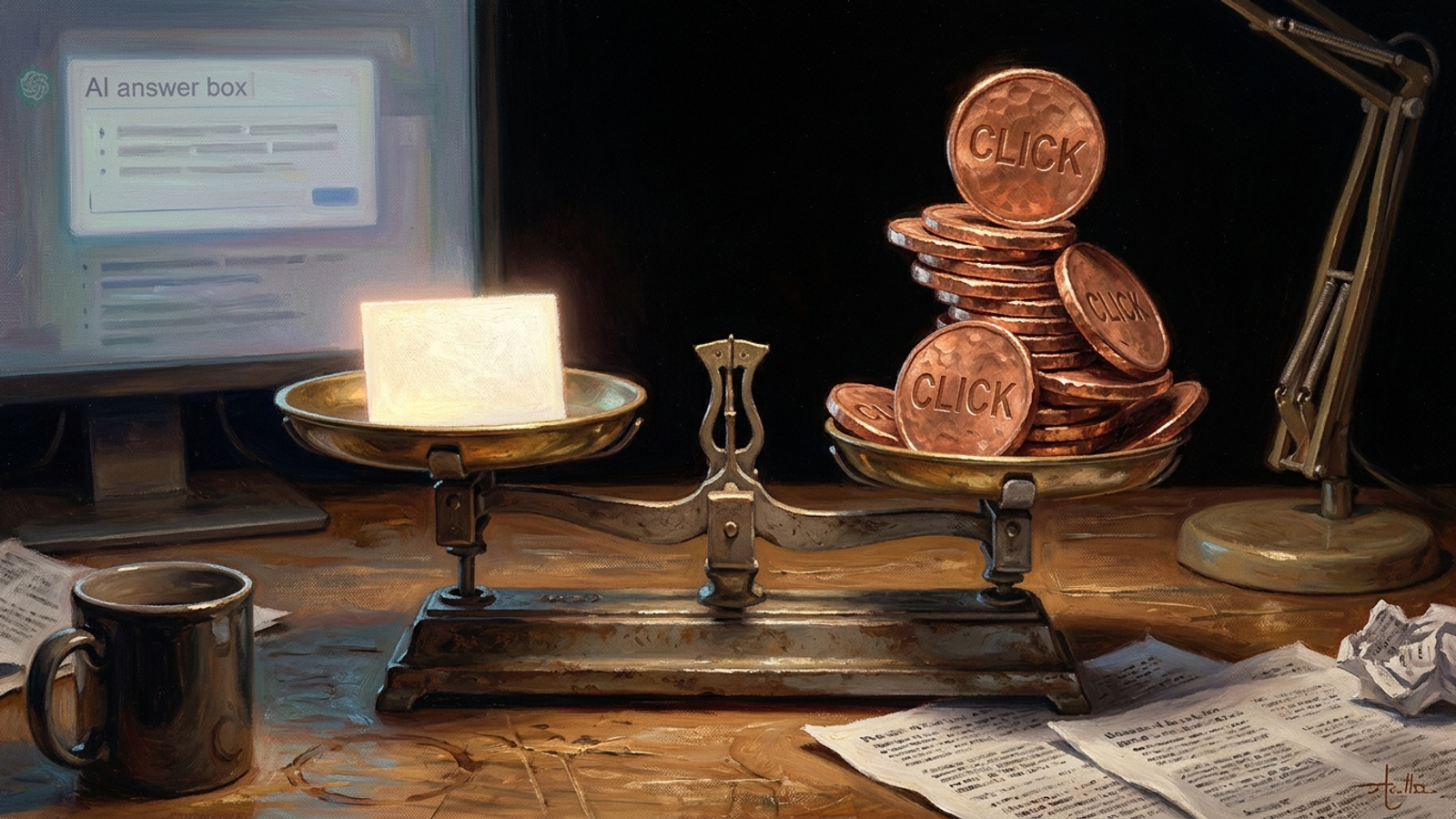
That is my boldest call, but it is not the whole bet. As ads move into answers, the organic citation becomes the one trust signal in that answer the ad cannot buy. Paid search has run this play before: add inventory, push unpaid results farther away, and make the remaining organic click harder to earn. The AI answer gives that pattern a new surface.
Here are five dated predictions. Each has a mechanism, evidence available now, and a way to prove me wrong. First, the short history that makes the bet worth placing.
2000: AdWords puts paid above organic
Google’s early arrangement was a legible trade: ads up top, organic results below. A business could pay for placement or earn a result. A reader could see the difference. The page made room for both, but the paid placement came first.
For practitioners, that order mattered. Earning an organic result did not mean owning the first thing a searcher saw. Placement and credibility were separate assets, even when they appeared on the same page.
2012: Product Search turns free visibility into paid inventory
The Knowledge Graph put direct answers near the top of results. That October, Google completed the move of Product Search to paid-only listings, with bidding joining relevance as a ranking factor. Merchants who had built around free product visibility now had to account for a paid slot.
I used to treat that Shopping change as a one-off. I was wrong. It showed how a useful discovery format could become an auction. If you depend on a format for free exposure, watch what happens when that format starts selling space.
February 2016: Inline ads push organic farther down
Google removed right-rail text ads and moved to three or four top inline ads, with another three or four at the bottom. The change did not erase organic results. It made the first one harder to reach on pages with more ads ahead of it.
That distinction is the precedent for AI answers. More paid space can make the remaining earned position scarcer without making it disappear. The question for an advertiser is no longer just whether an organic result exists. It is whether a buyer notices it, trusts it, and clicks it after encountering the paid placements.
May 2025: Ads enter the AI Overview
Google unveiled Search and Shopping ads embedded in AI Overviews for complex queries, then said it would expand that inventory beyond the US to select English-speaking markets by the end of 2025. This is the turning point for the format: the ad is no longer merely competing with the answer from outside the box. It can sit inside the answer experience.
The practical consequence is familiar. What the deck calls monetization, I call rent going up on attention you used to earn for free. When paid moves inside a format, an unpaid mention inside that format matters more.
June 2026: Chat answers show where the boundary might hold
Google is not the only answer surface selling or considering ad space. By June 2026, ChatGPT ads appeared in 26% of US desktop responses, up from 14% in May. Its ads were labeled and kept apart from the organic response. Perplexity, meanwhile, had stopped accepting new advertisers.
That is the present entry in this timeline. Answer companies are making different choices about ads, but those choices point to the same pressure: earn revenue without making a source citation look bought. My reading is that the boundary between an ad and a citation becomes the valuable part of the interface. Here is where I expect it to hold, and where I expect it to crack.
Prediction 1: Ads reach nearly every commercial AI Overview by December 31, 2027
The mechanism is inventory expansion. Google has already shown Search and Shopping ads inside generative responses for complex queries. I expect that placement to spread from complex research into straightforward buying searches: pricing, near me, and best provider queries. That is where advertisers already have a reason to bid. The dated history from SGE to ads inside Overviews lays out how the format reached this point.
This is a prediction, not a claim that those queries all carry ads today. I expect advertisers to accept the placement, Google to expand it, and the unpaid citation to share more answers with a paid unit. The citation will have to earn attention inside an increasingly priced space.
Here is the test. On December 31, 2027, run 20 unbranded commercial searches in your category where an AI Overview appears. If fewer than 18 show an ad inside that Overview, my “almost every” call misses. Do not count an ad above or below the box. I said inside.
Prediction 2: Cited sources get fewer clicks and better customers by June 2027
The click loss is already visible. An Ahrefs analysis of 300,000 keywords found a 34.5% drop in position-one organic click-through when an Overview appeared. An Amsive study of 700,000 keywords found a 15.49% average drop, rising to 37.04% when an Overview appeared with a featured snippet. Pew tracking of 68,879 searches found that users clicked a traditional result on 8% of visits with an AI summary, versus 15% without. Only 1% clicked links inside the Overview. Fewer people leave the answer.
My prediction concerns the people who still do. Seer data shows paid-link CTR falling from 13% to 6% when Overviews are present, while cited brands earn roughly 35% more organic clicks than uncited brands in the same answer. Those figures do not prove that a cited visitor converts better. They explain why I think that visitor might: the answer can give a buyer the framing on price, scope, and tradeoffs before the buyer reaches your site.
Say you run a $20k/month account. If informational clicks fall by a third but the visitors who click your citation arrive with fewer basic questions, the smaller stream could produce a higher on-page conversion rate. Volume down, conversion rate up. I used to treat every lost click as a lost opportunity. That was too blunt; some people who do not click were never going to buy.
By June 2027, I expect cited pages to convert their answer-driven visitors at a higher on-page rate than those same pages converted classic organic visitors in 2024. If the rates are equal or lower, I am wrong. Until then, do not report citation success as a click count alone. Check what those clicks do.
Prediction 3: ChatGPT and Perplexity keep ads out of numbered citations through 2027
The mechanism is trust protection. OpenAI began testing ads on February 9, 2026, on Free and Go tiers, placing clearly labeled sponsored units below the organic response. It opened self-serve Ads Manager on May 5. OpenAI says the ads run on separate systems and advertisers cannot shape or rank organic responses. The same reporting puts 66.3% of those ads after the second prompt and click-through around 0.50%. So far, selling an ad has not meant selling a source number.
Perplexity is the stricter case. It trialed sponsored follow-ups and side units from late 2024 with Indeed, Whole Foods, Universal McCann, and PMG. It then stopped accepting new advertisers in late 2025 and said it had no plans to pursue advertising, citing the risk that users would start doubting everything.
My call for December 31, 2027: if either product shows a paid unit, it will be visibly labeled and outside the numbered citations in the answer text. The citation stays unbought in chat. A screenshot of a sponsored advertiser occupying a numbered citation in either product on that date proves me wrong. For now, treat a chat citation as earned visibility, not ad inventory you can reserve.
Prediction 4: A blended sponsored citation gets tested, then pulled back by December 31, 2026
Here is the call I am least comfortable making and most interested in checking. Auction pressure gives an answer company a reason to try a paid source that resembles an earned one: perhaps a citation number resolving to a bidder, perhaps a sponsored tag tucked into a source carousel. Google’s 2012 move to paid-only Product Search listings shows the commercial temptation. It does not establish that anyone has run this particular test.
The reason I expect a pullback is also visible now. Perplexity has warned that ads touching answers could make users doubt everything. OpenAI has drawn a boundary with separate ad systems that cannot shape organic responses. A citation-like ad would press directly on that boundary. If a paid source looks earned, the answer asks readers to trust a distinction they can no longer see.
Before December 31, 2026, I expect at least one public test of a paid source or sponsored link inside answer text, followed by a rollback or clearer labeling after complaints. I am wrong if no such test surfaces by then, or if a blended format launches and stays without added disclosure. If one appears, check the label before you count it as an organic citation.
Prediction 5: Uncited advertisers pay more per qualified lead by Q4 2027
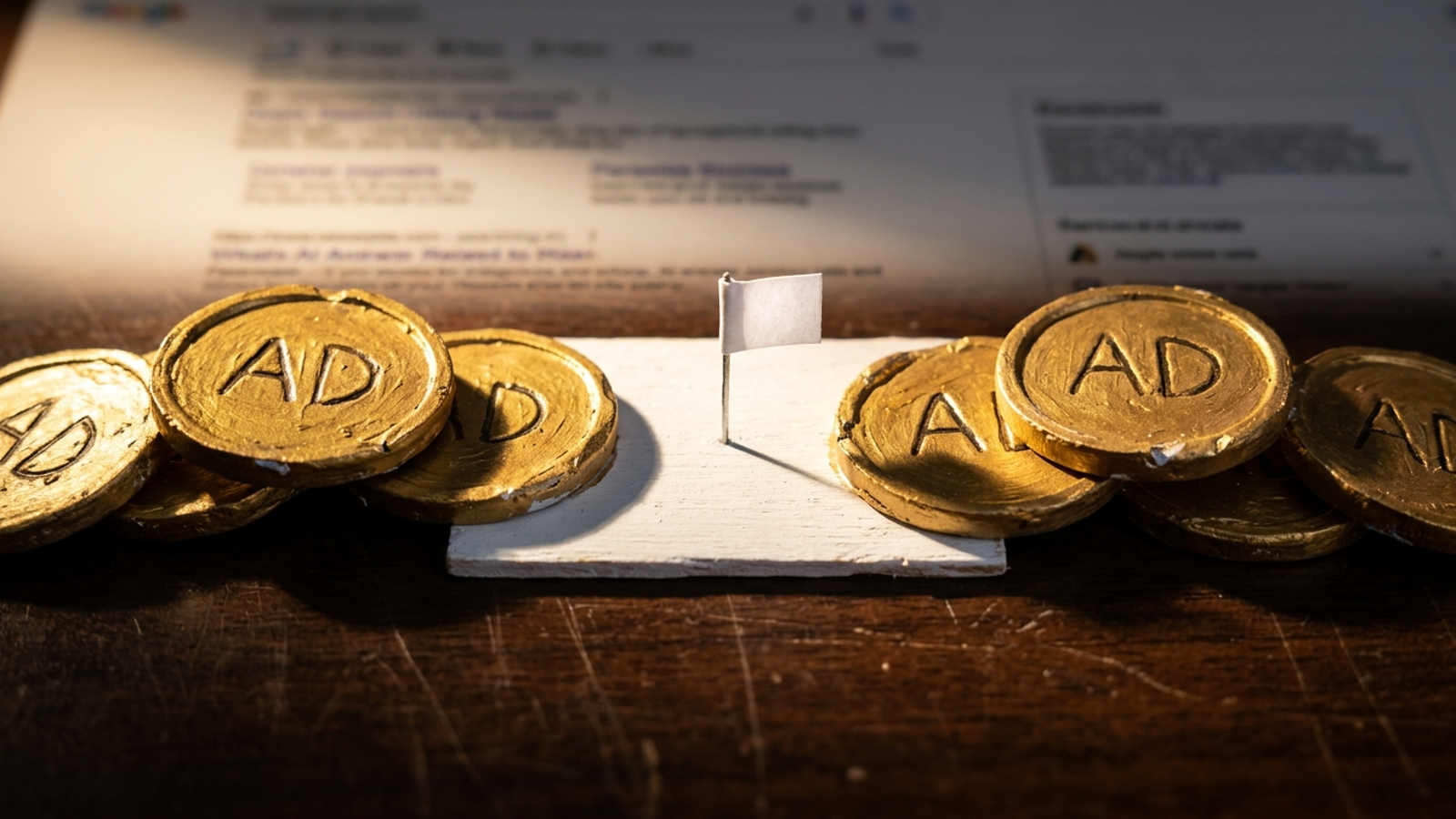
An uncited business faces two problems in an answer that contains ads: paid links draw fewer clicks when Overviews appear, and the business earns none of the clicks going to cited sources. The available figures put paid-link CTR at 6% with Overviews, down from 13%, while cited brands take roughly 35% more organic clicks than uncited brands in the same answer. Those are observations, not proof of a cost penalty. The cost penalty is my prediction.
Here is the mechanism. An account team that loses volume may widen match, pursue more queries, or raise bids to hold its lead count steady. Say you spend $20k/month on ten commercial terms and end up covering thirty to recover volume. The added queries can bring in less-qualified leads, and the spend still has to clear your cost-per-qualified-lead target. Meanwhile, a cited competitor has another route into the buyer’s consideration. A citation can reduce how much work the paid click has to do.
By Q4 2027, I expect advertisers with no Overview or chat citation footprint in their category to show 15% to 25% higher blended cost per qualified lead than cited competitors at similar budgets, all else held equal. Find five competitive sets where uncited advertisers pay the same or less per sales-qualified lead across a full quarter, and this call fails. I used to tell clients paid and organic were separate budgets with separate returns. Once an ad and a citation share the answer, that separation looks increasingly like accounting fiction.
The scorecard: what would kill the thesis
I want these calls scored, not shared as vibes. The tests are straightforward:
- December 31, 2027: Fewer than 18 of 20 eligible commercial AI Overviews show an ad inside the answer.
- June 2027: Cited answer-driven visitors convert on-page at the same or a lower rate than comparable classic-organic visitors did in 2024.
- December 31, 2027: ChatGPT or Perplexity lets an advertiser occupy a numbered citation in answer text.
- December 31, 2026: No blended sponsored-source test surfaces, or one launches and stays without clearer disclosure.
- Q4 2027: Uncited advertisers match or beat cited competitors on cost per sales-qualified lead across five comparable competitive sets.
Any two failures kill my thesis. One would force a narrower version of it. If a citation stays unbought, it remains distinct from the ad; if it goes up for sale, my argument about its trust value breaks. Keep that distinction in the scorecard, not just in a slide deck.
What to do in the next two quarters
Start with the buyer questions where you are invisible. Pull 30 real prompts from sales calls, search terms, and support tickets. Run each in Google AI Overviews, ChatGPT, and Perplexity. Record whether you are cited, a competitor is cited, or nobody useful is cited. The gap I often find is a business ranking for a few head terms while missing the longer questions that settle a purchase. If you need to decide where to focus first, this breakdown of Google AI Overviews vs ChatGPT vs Perplexity gives you an order of operations. You cannot earn citations for questions you have never listed.
Then fix the pages those questions should lead to. Put a 40- to 60-word direct answer near the top: who the offer fits, what it costs or requires, and the tradeoff to expect. Follow it with the proof a buyer would ask for, such as pricing ranges, timelines, service areas, and a dated update. I run paid and citation work together inside groas, with shared guardrails and an action log, because the page that earns a citation is often the page I want an ad to land on too.
Do two pages a week for a quarter. If my predictions hold, you walk into 2027 with a chance to own the trust signal while competitors walk in holding only a higher bid. That is the whole bet.